Trees
What is a binary Tree
A binary tree is a tree-type non-linear data structure with a maximum of two children for each parent. Every node in a binary tree has a left and right reference along with the data element. The node at the top of the hierarchy of a tree is called the root node. The nodes that hold other sub-nodes are the parent nodes.
Common Terminology
- Node - A Tree node is a component which may contain it’s own values, and references to other nodes
- Root - The root is the node at the beginning of the tree
- K - A number that specifies the maximum number of children any node may have in a k-ary tree. In a binary tree, k = 2.
- Left - A reference to one child node, in a binary tree
- Right - A reference to the other child node, in a binary tree
- Edge - The edge in a tree is the link between a parent and child node
- Leaf - A leaf is a node that does not have any children
-
Height - The height of a tree is the number of edges from the root to the furthest leaf
-
There are two categories of traversals when it comes to trees:
-
1- Depth First
Depth first traversal is where we prioritize going through the depth (height) of the tree first. There are multiple ways to carry out depth first traversal, and each method changes the order in which we search/print the root
-
Pre-order: root » left » right

-
In-order: left » root » right

-
Post-order: left » right » root

The most common way to traverse through a tree is to use recursion. With these traversals, we rely on the call stack to navigate back up the tree when we have reached the end of a sub-path
-
-
2- Breadth First
Breadth first traversal iterates through the tree by going through each level of the tree node-by-node. So, given our starting tree one more time

-
Binary Tree Vs K-ary Trees
If Nodes are able have more than 2 child nodes, we call the tree that contains them a K-ary Tree. In this type of tree we use K to refer to the maximum number of children that each Node is able to have.
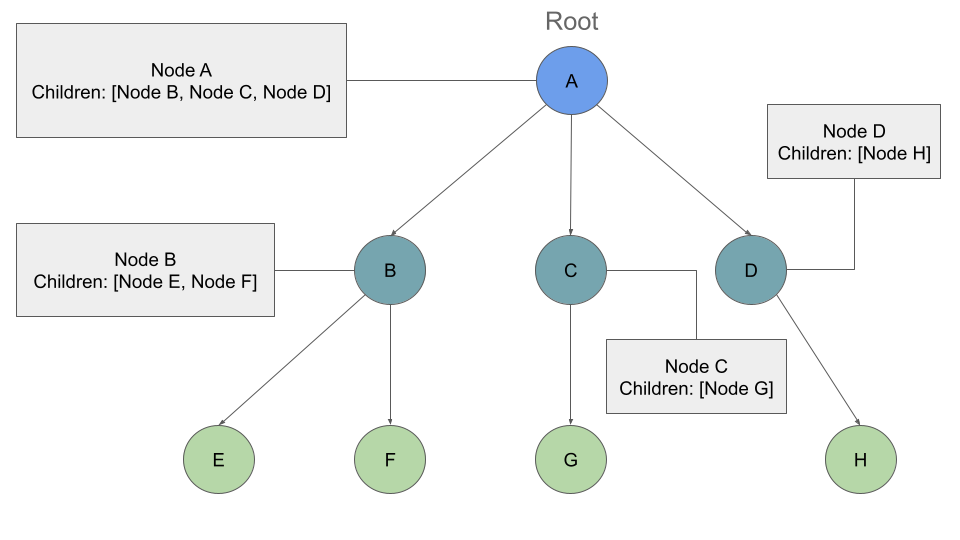
-
Adding a node
-
Because there are no structural rules for where nodes are “supposed to go” in a binary tree, it really doesn’t matter where a new node gets placed.
-
One strategy for adding a new node to a binary tree is to fill all “child” spots from the top down. To do so, we would leverage the use of breadth first traversal. During the traversal, we find the first node that does not have all it’s children filled, and insert the new node as a child. We fill the child slots from left to right.
-
In the event you would like to have a node placed in a specific location, you need to reference both the new node to create, and the parent node upon which the child is attached to.
-
Big O
-
The Big O time complexity for inserting a new node is
O(n). Searching for a specific node will also beO(n). Because of the lack of organizational structure in a Binary Tree, the worst case for most operations will involve traversing the entire tree. If we assume that a tree hasnnodes, then in the worst case we will have to look atnitems, hence theO(n)complexity. -
The Big O space complexity for a node insertion using breadth first insertion will be
O(w), where w is the largest width of the tree. For example, in the above tree,wis 4. -
A “perfect” binary tree is one where every non-leaf node has exactly two children. The maximum width for a perfect binary tree, is
2^(h-1), wherehis the height of the tree. Height can be calculated aslog n, wherenis the number of nodes.
-
-
-
Binary Search Trees
- A Binary Search Tree (BST) is a type of tree that does have some structure attached to it. In a BST, nodes are organized in a manner where all values that are smaller than the root are placed to the left, and all values that are larger than the root are placed to the right.
-
Big O
-
The Big O time complexity of a Binary Search Tree’s insertion and search operations is
O(h), orO(height). In the worst case, we will have to search all the way down to a leaf, which will require searching through as many nodes as the tree is tall. In a balanced (or “perfect”) tree, the height of the tree islog(n). In an unbalanced tree, the worst case height of the tree is n. -
The Big O space complexity of a BST search would be
O(1). During a search, we are not allocating any additional space.
-